
I had blamed Amazon and the seller—but guess what: there’s almost always a stack of books awaiting signing sitting in my living room, and when a box from a bookseller arrived, it got piled there—nearly a month ago.
My brother, who gave it to me for my birthday, was preparing to use his lawyer skills to get the thing replaced—and I just happened to look crosswise at that stack, and thought, you know, that’s a funny box to ship books in—thin. I picked it up—definitely from a bookseller—but light.
Y’know…
So I took it to the kitchen and opened it. [I don’t open boxes to be signed until I’m ready to sign.] And, yep, it was the Wacom board.
I’ve fired it up and given it a try. It’s not as precise as a pencil…maybe there are some adjustments: but I think the big problem is that pixels are square and I work on the diagonal—a lot. But after one day, I’ve got a prelim sketch done for a Rusalka cover. I think it’s pretty nice. Not too bad for a learning operation. It’s an Intuos 3: I had just asked for a Bamboo, because I’m not a paint artist, just a sketcher. But my brother found a refurb Intuos type, and it’s got a lot more whistles and bells. 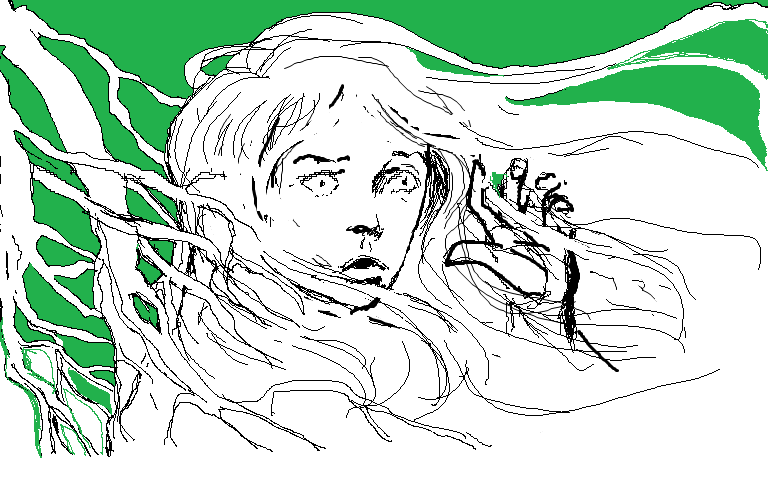
I’d settle for being able to draw that as a final not just as a prelim! Glad you found the board.
Me too; zippo talent for drawing.
Someday I hope to take lessons on how to draw, as i have no native/”untaught” talent to draw on. I’ve written a young child’s book and can see the appropriate illustrations so clearly in my mind and from such specific, distinct angles that I don’t want to hand it over to an unknown illustrator who will do it their way (mind, that’s not a risk if I don’t approach a publisher about the book but continue to have it a best-kept secret between my mind and my computer). I’m not really certain how young children’s authors handle the text to image translation. Surely I’m not the only one with intense visual images stuck in the mind but unable to flow out the fingers.
My drawing lesson for the day. 1 carton of boiled eggs in shells, a packet of rubber bands, and a pencil.
Take a rubber band and put it around the waist of the egg. use it to draw a line around the egg ‘waist’. Call it Line 1.
Do the same vertically. Call it line 2.
Do the same sort of line halfway between the waist and the bottom. Call it line 3.
And again—another line between that line and the bottom. This is line 4.
Now. On the intersection of line 1 and 2, with the egg facing you, draw a broad V about 1/4 inch from tip to tip.
On line one, draw 3 flattish half inch ovals very lightly. The center one should be bisected by line 2. Erase the center oval, and darken oval 1 and 3.
On line 4, draw a straight line exactly 2 ovals wide, bisected by line 4. draw another parallel line just under it, only 1 oval wide. Put a tiny tick at each end of the line 4 straight line.
Now—add an eyelid and lashes to the eyes…mere darkening of the upper oval will do.
Add a pupil to each eye. It’s a trick not to have them cross-eyed. Hint: in a normal human eye only the bottom half of the pupil and iris show unless the person is startled or irate. The eyelid covers the part of the oval not showing the pupil and iris.
add a little darkening at either side of the upper arms of the V. Nostrils.
Make a little dot in the middle of the mouth line on 4, and make the line underneath that into the shadow of the lower lip.
Modify the generality into personality; eat your mistakes.
Have fun.
I would recommend Drawing on the Right Side of the Brain by Betty Edwards. It takes your through a series of exercises that *really do* teach you to draw. I have used Dr. Edwards’s method successfully with all sorts of people. If you are comfortable in groups search out community art centers or continuing education classes in local high schools and colleges.
I firmly believe that everyone can learn to draw. Not everyone will be Rembrandt, but through the act of drawing you will learn to look at art and your surroundings from a new perspective……a different light so to speak! 😉 8) (Dismounting from hobby horse without getting caught in rockers.)
I can’t draw, but my mother was a lovely amateur artist. About 45 years ago she copied some paintings from Robin Hood and Moby Dick for the local (very small town) library, and just this past Friday my father sent me copies – what fun. Little John knocking Robin off the bridge, and the little whaling boat just in front of the big square rigged ship. I do wish I had half her skill. I tried today to decorate some cupcakes for my 11 year old’s birthday – we have a cupcake book that shows you how to make penguins, pandas and horses. Since she is horse mad this summer we tried the horses. There is a skill involved that I have not developed. Circus peanuts for the head, sugar wafers for the neck, lots of icing to hold it all together, jimmies and so on. I lack the fine motor skills. But the people at the stables could clearly see they were intended to be horses, and they tasted fine.
I will give you a free trick: it’s called a bridge. Most artists use them in some form. It consists of either bracing the little finger on something solid as the hand flexes and draws or positions something, or actually designing something on which to rest the side or heel of the hand while positioning something or drawing a very fine line. The bridge prevents smearing your own ink—or icing in this case, or just shaking so much you can’t get a clean mark. I’ve seen them fashioned out of a spare brush and a couple of rubber bands, or just about anything. Tis the nature of hands to wobble. Generations of artists have come up with all sorts of stabilizers.
I used that right side of the brain thing to teach too – scene – a room full of 18 yearolds with lots of large sheets of paper on big easels, charcoal, and a young, lithe female person with no clothes on. males are glassy-eyed, all panicking a bit. I say, right, stand right next to your easel with your drawing arm free to draw, but so that you can’t see the paper (no cheating). model takes an active sort of a pose, holds it for 60 secs, changes. this goes on for an hour, all drawing like mad on the same piece of paper. it makes them look at what they are drawing, not the drawing itself, (most spend far too much time looking at the wrong thing) and produces a dense charcoal drawing (almost like an abstract painting)of the essence of what they are looking at. loosens them all up wonderfully!
The bridge concept sounds helpful. The other thing that would help is the proper cupcake decorating tools. This book said, don’t bother with fancy icing dispensers, just shove the stuff into a plastic bag and snip the end off. That worked moderately well but I think would work better for someone actually skilled. Also, I kept getting chocolate icing on my fingers and when I wanted to put the eyes on the chocolate got all over the whites of the horses’ eyes. Also, the sugar wafer cookies, which were the necks, and the circus peanuts, which were the heads, kept being too heavy to be held up by the cupcakes.
But enough about my misadventures in cupcake cookery. Your drawing above is lovely and so evocative of Rusalka.
Ah, thank you!
And another thing artists use: frisket. Stickypaper that you cut into a stencil with a special little knife. Stick it on tight, paint away, lift the frisket off, and you have a safe other area.
Ohh, I want one of those! My jaw dropped when I looked at those online recently. It’s been a long time since I drew on a regular basis, but I should be able to at least pick up where I left off, and (I hope) learn from there. Don’t know if the pictures in my head will come out the way I see them, but it sure would be fun to try.
Gorgeous drawing! Regarding drawing on the diagonal (and I do the same thing): try slanting the board, even just as an exercise, and see if you can reconcile that with the vertical screen—or even tilt the computer screen to match. When I first used my tablet, I had the dickens of a time trying to find a good angle to draw at. Practice definitely helps, as does having a program that can use the pen-tilt and pen-pressure data that the tablet sends to the computer, as it really frees you up to just draw intuitively, and not have to be thinking of changing brush width/opacity all the time for pencilling stuff in. Did you install one of the apps it comes with (Corel, Ps Elements, etc), or do you already have a drawing program? I’ve been using Photoshop (and later Flash) to draw in, but have not tried other programs for years. I’d definitely just sit down and do some sketching and get the hang of how the pen behaves, but it looks like you’ve got that covered (ooh, bad pun)!